Business growth requires more than increasing sales, hiring employees or expanding operations. It also requires the right digital foundation.
Digital readiness is your business’s ability to use technology, digital systems and processes effectively to support current operations and future growth.
A business may already have a website, business email, cloud applications and digital marketing channels. However, simply having these tools does not necessarily mean they are connected, secure, efficient or capable of supporting expansion.
As your business grows, gaps in technology, communication, data management and operational processes can become increasingly difficult to manage.
So, how do you know whether your business is digitally ready?
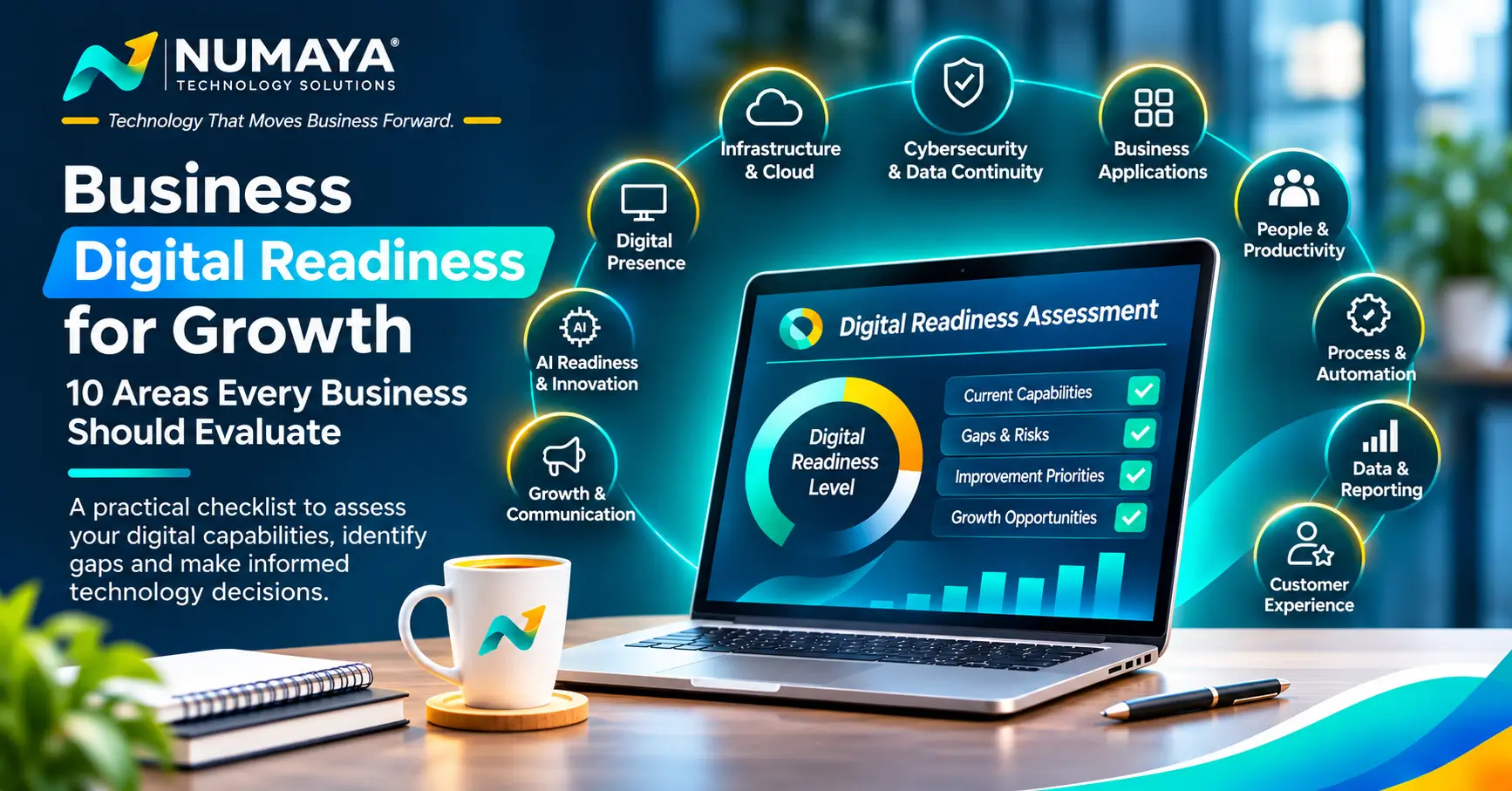
The answer starts with evaluating the essential areas of your digital environment. Here are ten areas every business should review before making its next technology investment.
1. Digital Presence and Online Visibility
Your digital presence is often the first point of interaction between your business and potential customers.
A professional website, accurate business information and a consistent online presence help establish credibility and make it easier for customers to understand your offerings.
Evaluate the following:
- Is your website professional, accessible and mobile-friendly?
- Can visitors easily understand your products or services?
- Are your contact details and enquiry options easy to find?
- Can potential customers discover your business through relevant online searches?
- Does your website support your current business objectives?
A website should do more than display information. It should help customers take meaningful actions, such as making an enquiry, requesting a consultation or purchasing a product.
Growth consideration: Your digital presence should evolve as your business, customer expectations and market positioning change.
2. IT Infrastructure and Cloud Readiness
Your technology infrastructure supports everyday business activities, from communication and file storage to application access and operational management.
An infrastructure that worked for a small team may become difficult to manage as the organisation expands.
Review your current environment:
- Are business devices and systems reliable?
- Is your business email professionally configured?
- Are files stored in organised and accessible locations?
- Are cloud platforms being used effectively?
- Can employees access the systems they need securely?
- Is your infrastructure capable of supporting additional users and workloads?
Cloud solutions can help businesses improve collaboration, accessibility and scalability. However, adopting cloud technology without planning data management, permissions and security can introduce new challenges.
Growth consideration: Build an infrastructure that can accommodate changing business requirements without unnecessary complexity.
3. Cybersecurity and Data Protection
Cybersecurity should be considered a fundamental business requirement, not an optional technology upgrade.
Businesses manage valuable information, including customer details, financial records, employee information, commercial documents and operational data.
Weak security practices can expose this information to unauthorised access, disruption or loss.
Evaluate whether your business has:
- Appropriate user access controls and permissions.
- Strong authentication practices.
- Updated operating systems and applications.
- Protection against common cyber threats.
- Employee awareness of phishing and suspicious communications.
- Documented procedures for responding to security incidents.
Security requirements should grow alongside your business. More employees, applications, devices and external connections can create additional areas that require protection.
Growth consideration: Establish appropriate security practices before expanding your digital environment.
4. Data Backup and Business Continuity
Having business data is important. Being able to recover it when something goes wrong is equally important.
Accidental deletion, hardware failure, cyber incidents and unexpected disruptions can affect business operations.
A reliable backup and continuity strategy helps reduce the impact of such situations.
Ask yourself:
- Is important business data backed up regularly?
- Are backups stored securely?
- Can data be restored when required?
- Are backup responsibilities clearly assigned?
- Does the business have a recovery plan for critical systems?
- Are recovery arrangements periodically tested?
Simply enabling a backup service does not guarantee that your information can be recovered successfully.
Growth consideration: Protect the information and systems your business depends on, and make recovery planning part of normal operations.
5. Business Applications and Software Management
Most businesses rely on several applications to manage accounting, sales, customer information, inventory, communication and daily operations.
Problems arise when these applications are selected independently and do not work together effectively.
Review your software environment:
- Do your applications support actual business requirements?
- Are employees using multiple tools for the same purpose?
- Is customer information maintained consistently?
- Can important systems exchange information?
- Are subscriptions and licences being managed?
- Are employees trained to use the applications effectively?
The objective is not to accumulate more software. It is to build a practical application environment that supports business processes.
Growth consideration: Choose applications that solve defined problems and can integrate with your wider business environment.
6. Data Management, Reporting and Business Visibility
Business decisions become difficult when important information is scattered across spreadsheets, emails and disconnected applications.
Effective data management helps business owners understand what is happening across their organisation.
Evaluate whether you can access useful information about:
- Sales and revenue performance.
- Customer enquiries and follow-ups.
- Business expenses and operational activities.
- Employee productivity and workload.
- Service delivery and customer satisfaction.
- Important operational and financial indicators.
You do not necessarily need an expensive business intelligence platform to improve reporting.
Sometimes, organising existing information and establishing consistent reporting processes can provide a much clearer picture.
Growth consideration: Make business information accessible, organised and useful for decision-making.
7. Customer Experience and Digital Engagement
Your customers experience your business through multiple interactions, including your website, email, telephone, social media and service channels.
As the business grows, maintaining a consistent customer experience becomes more challenging.
Consider these questions:
- Can customers easily contact your business?
- Are enquiries acknowledged and followed up?
- Is customer information recorded appropriately?
- Are communication processes consistent?
- Can your team track customer requests?
- Do you collect and review customer feedback?
Digital tools can help organise communication and improve customer engagement, but technology should support a well-designed customer process rather than replace it.
Growth consideration: Create connected customer journeys that make it easier for people to discover, contact and work with your business.
8. People, Productivity and Digital Workplace
Technology investments deliver value only when employees can use them effectively.
A business may have modern applications and cloud platforms, but inconsistent usage, limited training and unclear responsibilities can reduce their effectiveness.
Evaluate your digital workplace:
- Do employees have access to appropriate tools?
- Are communication and collaboration processes organised?
- Are documents and shared resources easy to find?
- Are employees comfortable using business applications?
- Are responsibilities for digital systems clearly defined?
- Is there a process for introducing and training employees on new tools?
Digital readiness is not just about technology. It also involves people, skills and working practices.
Growth consideration: Develop a digital workplace that helps employees collaborate, communicate and perform their responsibilities effectively.
9. Process Automation and System Integration
Manual processes can become difficult to manage as transaction volumes, customer enquiries and operational responsibilities increase.
Automation and integration can help reduce repetitive work and improve consistency.
Look for opportunities in activities such as:
- Customer enquiry registration and follow-up.
- Appointment scheduling and reminders.
- Document generation and approval workflows.
- Invoice and payment notifications.
- Data transfer between business applications.
- Routine reporting and notifications.
Before automating a process, understand how it currently works and identify unnecessary steps.
Automating an inefficient process can simply make the inefficiency happen faster.
Growth consideration: Improve processes first, then introduce appropriate automation and integration where they provide measurable business value.
10. AI Readiness and Digital Innovation
Artificial intelligence and emerging digital technologies are creating new opportunities for businesses to improve how they operate.
However, adopting AI simply because it is popular is not a digital strategy.
Businesses should first identify where intelligent tools can address genuine requirements.
Potential areas include:
- Drafting and organising business communications.
- Supporting customer service workflows.
- Analysing business information.
- Assisting with document processing.
- Improving internal knowledge access.
- Supporting repetitive administrative activities.
Before adopting AI solutions, consider data privacy, accuracy, human oversight, security and integration with existing systems.
Not every business needs advanced AI capabilities immediately. The right starting point depends on its digital maturity and business objectives.
Growth consideration: Explore AI and innovation opportunities when your processes, data and technology environment are ready to support them.
How to Evaluate Your Business’s Digital Readiness
Reviewing these ten areas gives you a useful starting point, but the real value comes from understanding how they work together.
For example, a business may have a professional website but lack an organised enquiry management process. Another may use cloud applications but have insufficient backup and access management practices.
These are different problems requiring different priorities.
A simple initial review can use three categories:
- Working well: Existing capabilities adequately support business requirements.
- Needs improvement: Some gaps or limitations need attention.
- Requires priority attention: Significant weaknesses or risks should be addressed.
This is an initial self-review, not a formal certification or technical security audit.
A structured assessment can provide a more complete understanding of your digital environment and help translate observations into practical recommendations.
Take the Next Step with Numaya Digital Health Assessment
Digital readiness is not a destination that businesses reach once and never revisit. It evolves as your organisation grows, customer expectations change and technology develops.
The important question is whether your existing digital capabilities are appropriate for your current requirements and future objectives.
At Numaya Technology Solutions, the Numaya Digital Health Assessment (NDHA) provides a structured approach to evaluating business technology capabilities, identifying digital gaps and understanding improvement opportunities.
The assessment helps business owners gain a clearer picture of their digital environment before committing to new technology investments.
You can explore the NDHA Framework to understand the assessment approach or review the NDHA Sample Report to see how findings and recommendations are presented.
Ready to understand your business’s digital readiness?
Start with an assessment before making your next technology decision.
Book Your Numaya Digital Health Assessment
Understand where you stand. Identify what needs improvement. Build a stronger digital foundation for growth.
About Numaya Technology Solutions
Numaya Technology Solutions helps startups, small businesses and MSMEs build structured, scalable and intelligent digital systems through technology consulting and digital solutions. Our approach focuses on understanding business needs, identifying opportunities and recommending practical technology improvements.