
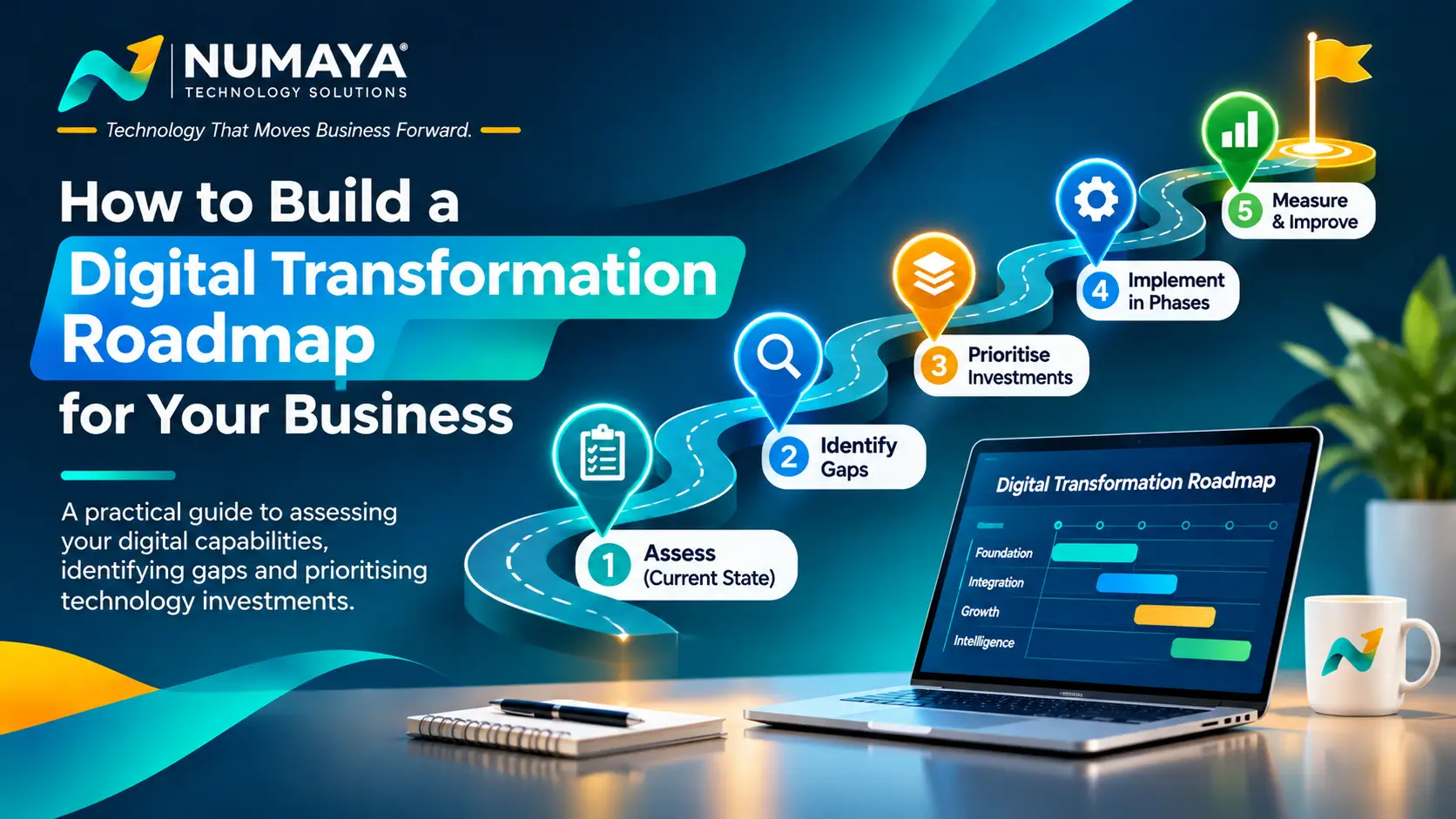
A digital transformation roadmap is a structured plan that helps a business understand its current technology environment, identify improvement opportunities and prioritise digital investments based on business objectives.
Rather than implementing multiple technologies at once, a roadmap establishes what needs to change, why it matters, what should happen first and how progress will be measured.
For small businesses and MSMEs, this approach is particularly important. Limited budgets, operational responsibilities and resource constraints make it essential to invest in technology that solves real business problems.
Building a successful roadmap starts with understanding your business, not selecting software.
1. Start with Your Business Objectives
Before evaluating technology, identify what you want your business to achieve.
Digital transformation should support business outcomes rather than become an independent technology project.
Consider questions such as:
- Do you want to generate more qualified enquiries?
- Are you trying to improve customer experience?
- Do you need better visibility into sales and operations?
- Are employees spending too much time on repetitive tasks?
- Do you want to improve data security and business continuity?
- Are you preparing your business for expansion?
Your answers will help establish the direction of your transformation.
For example, a business struggling with enquiry management may benefit more from a structured CRM and communication process than from investing in an entirely new enterprise software platform.
Similarly, a growing organisation concerned about data protection may need to prioritise cybersecurity, access management and backup arrangements before introducing additional applications.
The principle is simple: define the business problem before selecting the technology solution.
2. Assess Your Current Digital Capabilities
Once your objectives are clear, evaluate your existing digital environment.
This step establishes your starting position and helps identify the difference between where your business is today and where it needs to be.
Review the major areas of your digital operations:
- Digital presence: Website, online visibility, customer experience and enquiry channels.
- Infrastructure and cloud: Hosting, business email, cloud platforms and workplace technology.
- Cybersecurity and data continuity: Security controls, access management, backup and recovery arrangements.
- Business applications: Accounting, CRM, ERP and other operational software.
- Growth and communication: Digital marketing, customer engagement and communication platforms.
- AI and business systems: Automation opportunities, system integration and intelligent workflows.
Do not assume that every area needs immediate investment. Some systems may already be performing well, while others may require improvement or replacement.
The Numaya Digital Health Assessment (NDHA) provides a structured way to understand these capabilities, identify gaps and establish improvement priorities.
Explore the Numaya Digital Health Assessment Framework to understand how your business’s digital environment can be evaluated.
3. Identify and Prioritise Digital Gaps
An assessment may reveal several improvement opportunities, but not everything should be implemented simultaneously.
The next step is to organise findings according to business impact, urgency, dependencies and available resources.
A useful prioritisation approach considers three levels:
Critical priorities: Issues that create significant operational, security or business continuity risks and require attention.
Growth priorities: Improvements that directly support customer acquisition, service delivery, operational efficiency or business expansion.
Future opportunities: Enhancements that may provide value later but are not essential to current business objectives.
For instance, improving business email security may deserve attention before introducing an advanced marketing automation platform.
Likewise, establishing a reliable enquiry management process may be more valuable than purchasing several disconnected marketing tools.
A roadmap should explain why each initiative matters, what problem it addresses and what business outcome it is expected to support.
4. Create a Phased Digital Transformation Plan
Once priorities are established, organise initiatives into manageable implementation phases.
A phased approach helps businesses control investment, reduce disruption and evaluate progress before moving to the next stage.
A practical structure could look like this:
Phase 1 – Foundation
Establish essential digital capabilities, including business email, website reliability, security controls, data backup and basic productivity systems.
Phase 2 – Integration and Efficiency
Improve business workflows, introduce appropriate CRM or business applications, connect existing systems and reduce repetitive manual activities.
Phase 3 – Growth and Customer Experience
Strengthen digital presence, lead generation, customer communication, marketing processes and performance visibility.
Phase 4 – Intelligence and Scalability
Explore AI-enabled workflows, advanced automation, reporting and scalable digital infrastructure based on business readiness.
These phases are illustrative rather than a fixed implementation sequence. Your actual roadmap should reflect your assessment findings, business requirements, budget and operational dependencies.
The objective is to create a realistic plan that your organisation can execute without overwhelming its resources.
5. Estimate Investment, Resources and Dependencies
A roadmap becomes actionable when each initiative has a clear implementation requirement.
Before approving a technology investment, consider:
- Software licensing and subscription costs.
- Implementation, configuration and integration expenses.
- Infrastructure and hosting requirements.
- Employee training and adoption.
- Ongoing maintenance and support.
- Data migration and potential operational disruption.
Also identify dependencies between initiatives.
For example, implementing a CRM system may require cleaning existing customer records, defining enquiry stages and establishing ownership of follow-up activities.
Similarly, automating a business process without first understanding how that process works can create unnecessary complexity.
Do not evaluate technology only by its purchase price. Consider its implementation requirements, long-term operating costs and expected contribution to business objectives.
A practical roadmap should distinguish between essential investments, optional improvements and initiatives that can wait.
6. Assign Ownership and Define Success Measures
Digital transformation requires business participation, not just technical implementation.
Every major initiative should have an accountable owner, an expected outcome and a realistic target date.
Define how you will evaluate progress.
Depending on the initiative, useful measures may include:
- Time required to complete a business process.
- Number of enquiries received and followed up.
- Customer response and service delivery timelines.
- System availability and backup readiness.
- Adoption of newly implemented applications.
- Reduction in repetitive manual activities.
Establish a baseline before implementation wherever possible. This allows you to compare actual progress against the previous business situation.
Schedule periodic reviews to identify delays, adoption challenges and changes in business priorities.
A roadmap should remain practical and adaptable rather than becoming a document that is prepared once and forgotten.
7. Review, Improve and Evolve Your Roadmap
Business requirements change. New opportunities emerge, technology evolves and customer expectations develop.
Your digital transformation roadmap should therefore be reviewed regularly.
An initiative that was important six months ago may no longer be the highest priority. Similarly, a new operational challenge may require an adjustment to your implementation plan.
Review completed projects, assess their outcomes and revisit outstanding priorities.
If an implementation is not delivering the expected business value, investigate whether the issue relates to technology selection, process design, employee adoption or the original business requirement.
Continuous evaluation helps ensure that technology investments remain connected to business objectives.
Start Your Digital Transformation Journey with Numaya
Building a digital transformation roadmap does not have to begin with a major technology investment.
It begins with understanding where your business stands, what is holding it back and which improvements will make the greatest difference.
At Numaya Technology Solutions, our approach combines technology assessment, business-oriented consulting and practical digital solutions to help startups, small businesses and MSMEs build structured, scalable and intelligent digital systems.
The Numaya Digital Health Assessment (NDHA) provides a starting point for understanding your current digital capabilities, identifying gaps and establishing improvement priorities.
Following the assessment, your business can make more informed decisions about technology investments, implementation priorities and the next steps in its digital transformation journey.
Ready to understand where your business stands digitally?
Book Your Numaya Digital Health Assessment
Start with clarity. Prioritise with confidence. Transform with purpose.
About Numaya Technology Solutions
Numaya Technology Solutions helps startups, small businesses and MSMEs build structured, scalable and intelligent digital systems through technology consulting and digital solutions. Our approach focuses on understanding business needs, identifying opportunities and recommending practical technology improvements.